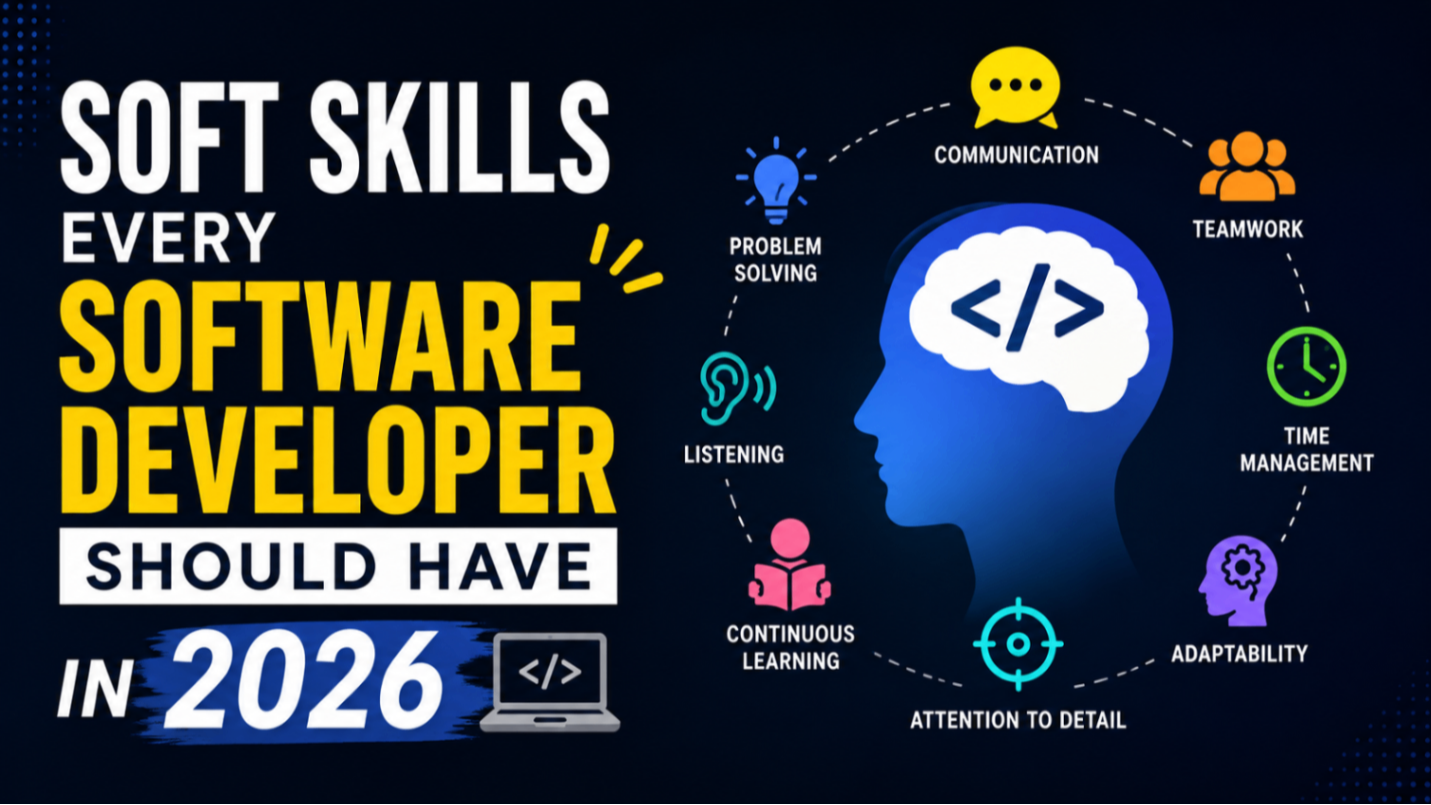
Soft Skills Every Software Developer Should Have in 2026
Knowing how to code is an important part of becoming a software developer. But technical knowledge is only one part of building a successful career in software development.
In a professional IT environment, developers communicate with teammates, understand requirements, solve unexpected problems, participate in meetings, manage deadlines and continuously learn new technologies.
That is why soft skills for software developers have become an important part of career development.
Whether you are learning Java, Python, JavaScript, Full Stack Development or another technology, developing professional skills alongside technical knowledge can help you become a more effective developer.
What Are Soft Skills for Software Developers?
Soft skills are personal and professional abilities that influence how effectively you communicate, collaborate, solve problems and work with others.
For software developers, these skills are particularly important because modern software development is usually a team-based activity.
A developer may work with:
- Other software developers
- UI/UX designers
- Software testers
- Business analysts
- Project managers
- Clients
- Technical leads
- Product teams
Technical knowledge helps you perform your role. Soft skills help you work effectively within that environment.
1. Communication Skills
Communication is one of the most important soft skills for software developers.
Developers frequently need to explain technical concepts to people with different levels of technical knowledge.
For example, a developer may need to explain:
- Why a particular technology was selected
- Why an application is experiencing an issue
- How a feature works
- What is required to complete a task
- Why a project deadline may change
Good communication doesn't mean using complicated technical terminology.
It means explaining the right information clearly to the right audience.
For freshers, developing communication skills can also make technical interviews and workplace interactions more comfortable.
2. Problem-Solving Skills
Software development is essentially a continuous problem-solving process.
A developer may encounter a bug that doesn't have an obvious solution, an application that performs slowly or a requirement that needs to be converted into working functionality.
Good developers don't simply search for an answer and copy it.
They learn to:
- Understand the problem.
- Break it into smaller parts.
- Identify possible causes.
- Test different solutions.
- Evaluate the result.
- Improve the solution when necessary.
This mindset is useful regardless of whether you are working with Java, Python, JavaScript or another programming language.
3. Teamwork
Modern software projects are rarely created by one person.
Developers work alongside people from different technical and business backgrounds.
A developer therefore needs to understand how to:
- Share information
- Accept feedback
- Help teammates
- Discuss technical decisions
- Respect different opinions
- Coordinate tasks
- Communicate project updates
Being technically strong but difficult to work with can create problems for a project.
Being technically strong and collaborative makes you a more valuable team member.
4. Adaptability
Technology changes quickly.
Programming languages evolve. Development frameworks are updated. New cloud platforms appear. Artificial intelligence is changing how developers approach many tasks.
Because of this, developers need to become comfortable with learning.
Adaptability doesn't mean learning every new technology.
It means being willing to understand new tools when they are relevant to your work.
For a fresher, this mindset is particularly useful because your first job may introduce technologies that were not part of your academic curriculum.
5. Time Management
Software development involves deadlines.
A developer may have multiple tasks at the same time, including development work, debugging, meetings, testing and documentation.
Time management helps developers decide:
- What needs immediate attention?
- Which task has the highest priority?
- How much time should be allocated to a task?
- When should a blocker be communicated?
- What can realistically be completed within a deadline?
Learning to manage time is especially important for freshers transitioning from academic projects to professional environments.
6. Attention to Detail
Software can fail because of very small mistakes.
A missing condition, incorrect database value or overlooked requirement can create unexpected behaviour.
Attention to detail helps developers identify potential problems before they become larger issues.
It also helps when reviewing:
- Code
- Requirements
- Test results
- Database queries
- User interfaces
- Documentation
Being careful doesn't mean being slow. It means developing a habit of checking important details.
7. Active Listening
Developers don't only need to explain things—they also need to listen.
A client or product manager may describe a business problem without using technical language.
The developer's responsibility is to understand what the person actually needs.
Active listening includes:
- Paying attention
- Asking relevant questions
- Confirming requirements
- Identifying unclear information
- Understanding the underlying problem
Sometimes the most valuable question a developer can ask is simply:
“What problem are we actually trying to solve?”
8. Continuous Learning
One of the most important skills for a long-term software development career is the ability to keep learning.
A developer doesn't stop learning after completing a degree or training program.
New tools, frameworks, platforms and development practices continue to emerge.
A strong learning habit can help developers remain relevant throughout their careers.
However, continuous learning doesn't mean chasing every trend.
A better approach is to build strong fundamentals first and then learn technologies that support your career direction.
9. Receiving and Giving Feedback
Feedback is part of professional software development.
Your code may be reviewed by another developer. A manager may suggest a different approach. A tester may identify an issue with your implementation.
Instead of treating feedback as criticism, developers can use it as an opportunity to improve.
Similarly, when giving feedback, developers should focus on the problem and the solution rather than the person.
Professional feedback should help the team produce better software.
10. Confidence to Ask Questions
Freshers sometimes hesitate to ask questions because they are afraid of appearing inexperienced.
But staying silent when requirements are unclear can create bigger problems later.
A good developer knows when to investigate independently and when to ask for clarification.
Asking a thoughtful question shows that you care about understanding the problem correctly.
Technical Skills + Soft Skills = Stronger IT Career Preparation
Technical skills remain essential for becoming a software developer.
Depending on your career path, these may include programming languages, databases, APIs, version control, frameworks and development tools.
But technical knowledge works best when combined with professional skills.
For example:
Programming + Problem-Solving helps you build better solutions.
Technical Knowledge + Communication helps you explain those solutions.
Coding + Teamwork helps you contribute to larger projects.
Technical Skills + Adaptability helps you continue learning as technology changes.
This combination is especially important for students and freshers preparing for their first IT job.
How Can Students Develop Soft Skills?
Soft skills are not developed only by reading about them.
Students can practice them through real activities.
Work on Team Projects
Team projects provide opportunities to communicate, divide responsibilities, manage deadlines and solve disagreements.
Explain What You Build
After completing a project, try explaining it to someone who doesn't have a technical background.
This is excellent communication practice.
Participate in Presentations
Presenting your project can improve confidence and help you explain technical information clearly.
Practice Problem-Solving
Don't immediately search for the solution when you encounter a programming problem.
Spend some time understanding the problem and developing your own approach first.
Take Feedback Seriously
Ask mentors, teachers and teammates what you can improve.
Then actually apply their feedback.
What Skills Should a Fresher Learn for an IT Job?
A fresher preparing for an IT career should think beyond programming languages.
A balanced preparation plan can include:
- Programming fundamentals
- Database and SQL knowledge
- Problem-solving
- Communication
- Teamwork
- Project experience
- Version control
- Interview preparation
- Resume building
- Continuous learning
The exact technical skills will depend on the career path you choose.
For example, someone preparing for Full Stack Development may focus on Java, JavaScript, databases and web technologies, while someone pursuing Data Analytics may focus on Excel, SQL, Power BI and data analysis.
Why Soft Skills Matter at SPRK Technologies
At SPRK Technologies, the goal of IT training is not simply to introduce students to programming languages or software tools.
Students preparing for an IT career need to understand how technical knowledge is applied in practical situations.
SPRK Technologies offers career-focused training across areas such as Full Stack Development, Data Analytics, Python, AI/ML and Software Development.
Building technical knowledge while developing communication, problem-solving and professional skills can give students a more balanced approach to IT career preparation.
Frequently Asked Questions
What are the most important soft skills for a software developer?
Communication, problem-solving, teamwork, adaptability, time management, attention to detail, active listening and continuous learning are important soft skills for software developers.
Are soft skills important for software developer jobs?
Yes. Software development is usually collaborative, so developers need to communicate with teammates, understand requirements, receive feedback and work toward shared project goals.
What soft skills should a software developer fresher have?
Freshers should focus particularly on communication, problem-solving, teamwork, adaptability and the confidence to ask questions when requirements are unclear.
Can soft skills improve an IT career?
Yes. Strong professional skills can help developers communicate more effectively, collaborate with teams, handle responsibilities and adapt to changing workplace requirements.
Are technical skills more important than soft skills?
Both matter. Technical skills are necessary to perform software development work, while soft skills help developers communicate, collaborate and solve problems effectively in professional environments.
Follow the Latest in Tech!
Stay updated with tips, tutorials, and trending tech insights. Connect with us on social media for more!