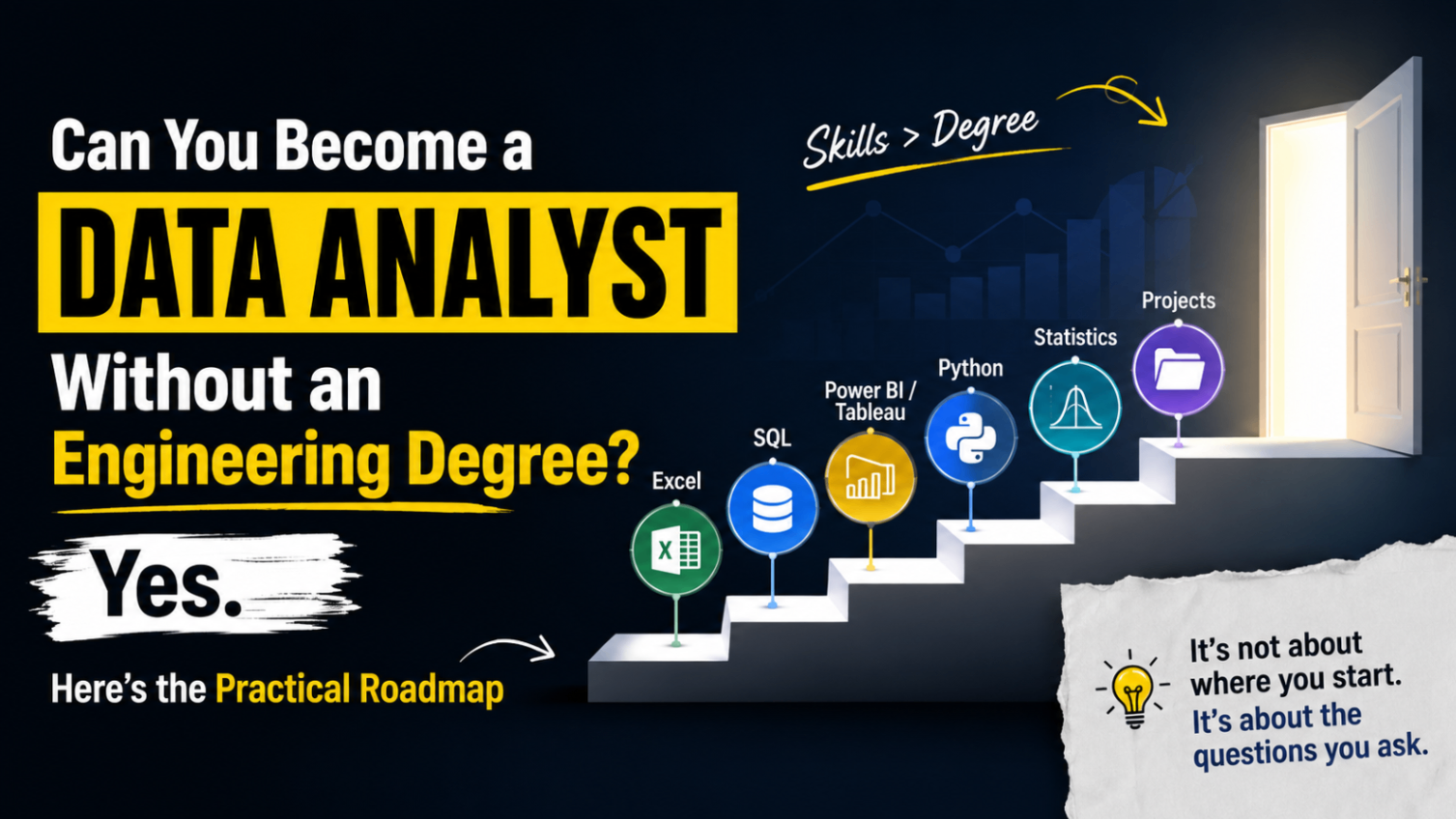
How to Become a Data Analyst Without an Engineering Degree
Do you need an engineering degree to become a Data Analyst?
No.
The Data Analytics industry is accessible to people from many educational backgrounds. While an engineering or computer science degree can be useful, it is not the only path into a career in data.
What matters more is developing practical skills in Excel, SQL, data visualization, statistics, Python and business analysis, and being able to demonstrate those skills through real-world projects.
With the growing use of AI, aspiring analysts should also understand how artificial intelligence can support modern data workflows.
What Does a Data Analyst Do?
A Data Analyst collects, cleans, analyzes and interprets data to help organizations make better decisions.
A typical Data Analyst may:
- Collect data from different sources
- Clean and prepare datasets
- Write SQL queries
- Analyze trends and patterns
- Create dashboards and reports
- Identify business problems through data
- Communicate findings to stakeholders
- Support data-driven decision-making
The role therefore requires more than technical knowledge. Business understanding and analytical thinking are equally important.
Can a Non-Engineering Graduate Become a Data Analyst?
Yes.
People from backgrounds such as:
- Commerce
- Finance
- Business Management
- Economics
- Mathematics
- Science
- Arts
- Marketing
- Operations
can develop the skills required for Data Analytics.
Your degree may influence your starting point, but it doesn't have to determine your destination.
For example, someone from a finance background may already understand business metrics and financial statements. A marketing graduate may understand customer behavior and campaign performance.
The goal is to combine that existing knowledge with technical data skills.
Skills You Need to Become a Data Analyst
1. Excel
Excel remains an excellent starting point for learning data analysis.
You should become comfortable with:
- Formulas
- Lookup functions
- PivotTables
- Data cleaning
- Conditional logic
- Charts
- Basic data analysis
Excel helps you develop an understanding of how raw information can be organized and analyzed.
2. SQL
SQL is one of the most important technical skills for a Data Analyst.
SQL allows analysts to retrieve and manipulate information stored in databases.
Important concepts include:
- SELECT
- WHERE
- GROUP BY
- ORDER BY
- JOIN
- CASE statements
- Subqueries
- Aggregate functions
- Window functions
Don't focus only on memorizing SQL syntax. Learn how to use SQL to answer business questions.
3. Power BI or Tableau
Data analysis isn't only about finding numbers.
You also need to communicate what those numbers mean.
Tools such as Power BI and Tableau help analysts create interactive dashboards and visual reports.
A good dashboard should answer questions such as:
What happened?
Why did it happen?
Which trends matter?
What should the business investigate next?
4. Statistics
You don't necessarily need advanced mathematics to start a Data Analyst career.
However, you should understand fundamental concepts such as:
- Mean, median and mode
- Percentages
- Variance and standard deviation
- Distributions
- Correlation
- Sampling
- Trends
- Basic probability
Statistics helps you avoid drawing incorrect conclusions from data.
5. Python for Data Analytics
Python can take your analytics skills further.
Common Python libraries used for data work include:
- Pandas
- NumPy
- Matplotlib
- Seaborn
- Scikit-learn
You can use Python for data cleaning, transformation, visualization, automation and more advanced analytical tasks.
For beginners, however, don't make the mistake of trying to learn everything at once.
A practical progression is:
Excel → SQL → Power BI → Python → Advanced Analytics
6. Learn AI for Data Analytics
AI is becoming an important part of the modern analyst's toolkit.
AI assistants can help analysts:
- Explain SQL queries
- Generate initial SQL or Python code
- Explore datasets
- Identify potential patterns
- Create documentation
- Automate repetitive tasks
- Brainstorm analytical approaches
But there's an important distinction:
Using AI does not automatically make someone a good Data Analyst.
An analyst still needs to validate data, understand context, check AI-generated outputs and determine whether an insight is actually meaningful.
The future Data Analyst is likely to be someone who combines:
Data skills + Business understanding + AI literacy + Critical thinking
7. Build Real-World Data Analytics Projects
One of the best ways to demonstrate your skills is through projects.
Instead of simply listing:
SQL | Excel | Power BI | Pythonon your resume, show what you actually built.
For example, you could create:
Sales Analytics Project
Analyze monthly revenue, products, regions and sales performance.
Customer Analytics Project
Analyze customer segments, retention and purchasing behavior.
Marketing Analytics Project
Study campaign performance, conversion rates and customer acquisition.
Financial Analytics Project
Analyze expenses, revenue, profitability and financial trends.
Each project should explain:
Problem → Data → Analysis → Insights → Business Recommendation
That structure demonstrates analytical thinking rather than just tool knowledge.
8. Create a Data Analyst Portfolio
A portfolio gives recruiters and employers evidence of your capabilities.
Your portfolio can include:
- SQL projects
- Power BI dashboards
- Excel analysis
- Python notebooks
- Business case studies
- Data visualization projects
For every project, explain what you were trying to solve and what you discovered.
A strong portfolio doesn't need dozens of projects.
Three to five well-explained projects can be more useful than twenty unfinished ones.
9. How Long Does It Take to Become a Data Analyst?
There is no fixed timeline.
Your learning speed depends on your previous experience, available study time and consistency.
A beginner could structure their learning journey like this:
| StageFocus | |
| Month 1 | Excel + Data Fundamentals |
| Month 2 | SQL |
| Month 3 | Power BI / Data Visualization |
| Month 4 | Statistics + Projects |
| Month 5 | Python |
| Month 6 | Portfolio + Interview Preparation |
The timeline is only an example. The important part is consistent practice and project-based learning.
Is a Data Analytics Course Necessary?
You don't necessarily need a formal course to learn Data Analytics.
There are many free and paid resources available.
However, a structured Data Analytics course can help reduce the time spent figuring out what to learn next.
A good program should ideally provide:
- Structured curriculum
- Practical assignments
- Real-world projects
- Mentor guidance
- Industry-relevant tools
- Interview preparation
- Portfolio development
The objective should not simply be to complete a syllabus.
The objective should be to become job-ready.
Final Thoughts
You don't need an engineering degree to start learning Data Analytics.
You need a clear roadmap and the willingness to practice.
Start with Excel and data fundamentals, move into SQL and visualization, develop Python and statistics, and increasingly learn how AI can support the analytical workflow.
Most importantly, build projects that demonstrate your ability to turn raw data into meaningful business insights.
At SPRK Technologies, our approach focuses on practical, industry-oriented learning so that students can build relevant skills and apply them to real-world problems.
Your degree may be where your career started. It doesn't have to determine where it goes next.
Visit for course details : https://www.sprktechnologies.in/data-analysis-with-power-bi
Follow the Latest in Tech!
Stay updated with tips, tutorials, and trending tech insights. Connect with us on social media for more!