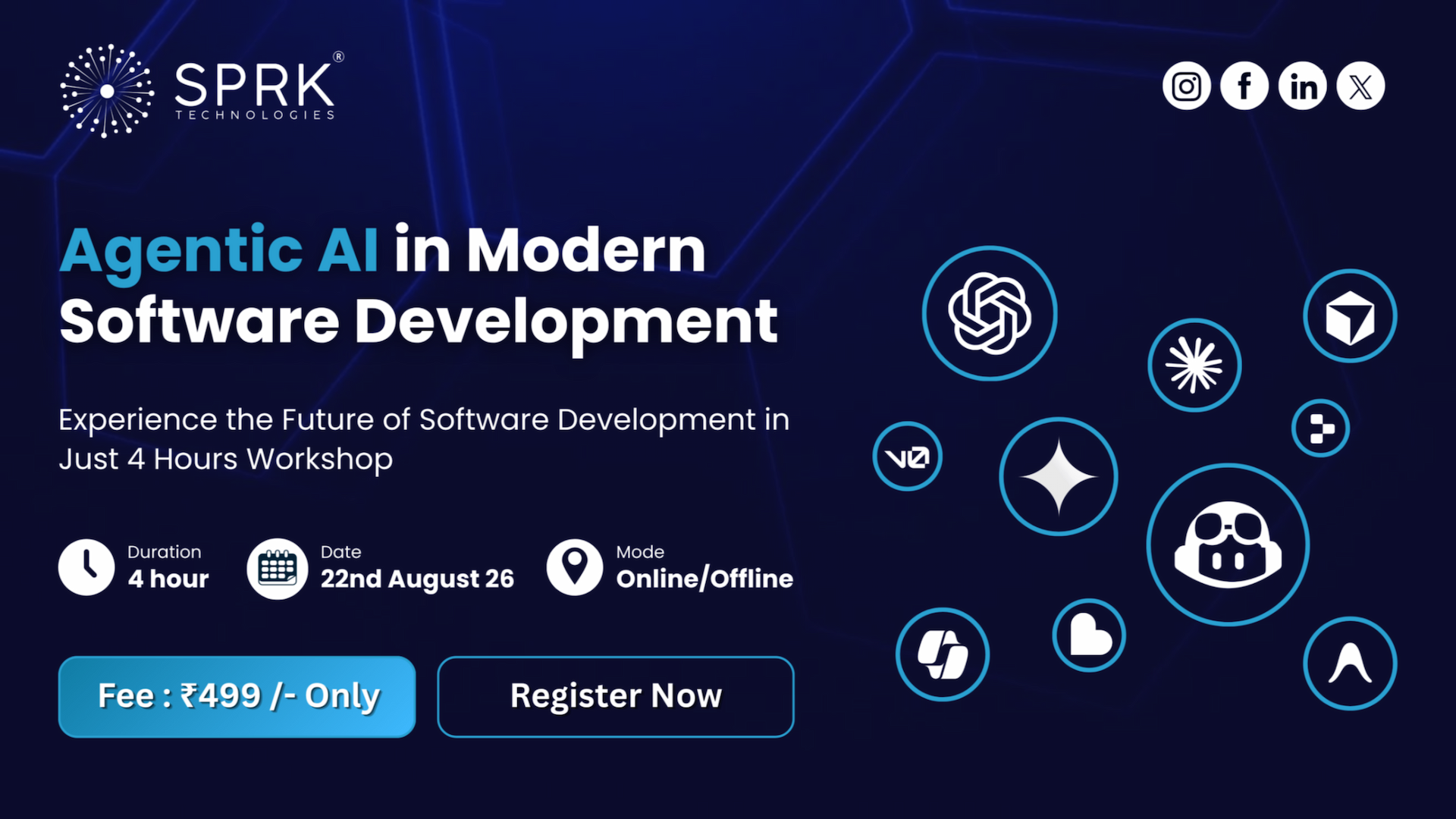
Agentic AI in Software Development
Artificial Intelligence is rapidly changing the way software is designed, developed, tested and maintained. While traditional AI tools and generative AI assistants can help developers write code, Agentic AI takes the next step by enabling AI agents to reason through tasks, use tools, collaborate with other agents and participate in complete software development workflows.
For software developers, technical leads, architects, QA professionals and DevOps engineers, understanding Agentic AI in software development is becoming increasingly important.
Instead of simply asking an AI chatbot to generate a piece of code, developers can use AI agents to analyse requirements, generate implementations, review code, identify security vulnerabilities, create functional tests and produce actionable reports.
This shift from AI-assisted coding to AI-powered software engineering workflows is one of the most important developments in modern software development.
What Is Agentic AI?
Agentic AI refers to AI systems designed to work toward a goal by reasoning, planning actions, using tools and completing multiple steps rather than simply responding to individual prompts.
A traditional AI assistant might answer:
"Write a Python function to process this data."
An AI agent can potentially work through a larger objective by breaking it into tasks, using appropriate tools and evaluating the results along the way.
In software development, an agentic workflow could look like:
Requirement → Planning → Code Generation → Code Review → Security Analysis → Testing → Reporting
This makes Agentic AI particularly valuable for software engineering teams looking to automate repetitive and multi-step development activities.
Research into Agentic AI increasingly describes these systems as capable of interpreting goals, planning multi-step tasks, interacting with tools and coordinating workflows, while emphasizing the importance of governance and human oversight.
Agentic AI vs Generative AI: What Is the Difference?
Generative AI is excellent at creating content such as text, code, documentation and summaries based on user instructions.
Agentic AI goes further by introducing goal-oriented workflows and action.
For example:
Generative AI
A developer asks:
"Review this code and identify potential bugs."
The AI analyses the supplied code and provides an answer.
Agentic AI
An agentic workflow can be designed to:
- Understand the software requirement
- Analyse the existing code
- Generate or modify implementation
- Review the generated code
- Check for security vulnerabilities
- Generate functional tests
- Execute tests
- Analyse the results
- Prepare an actionable report
- Request human approval before important actions
The important difference is not simply that one system is "smarter." The difference is the workflow architecture and ability to coordinate multiple tasks and tools toward a defined objective.
How Agentic AI Is Changing Software Development
The software development lifecycle contains many repetitive and time-consuming activities.
Agentic AI can potentially connect several of these activities into an integrated workflow.
Instead of using isolated AI prompts for individual tasks, teams can explore how multiple specialised AI agents can collaborate across the Software Development Lifecycle (SDLC).
This is one reason AI agents for software development are attracting increasing attention from developers and technology teams.
1. AI Agents for Requirements Analysis
The first stage of software development is understanding what needs to be built.
AI agents can assist with analysing requirements, identifying ambiguities, extracting important information and converting high-level requirements into structured development tasks.
For example, an AI-powered requirements agent could analyse a project specification and identify:
- Functional requirements
- Technical requirements
- Dependencies
- Potential edge cases
- Missing information
- Development tasks
This can help development teams move from an unstructured requirement to a clearer implementation plan.
2. AI-Powered Code Generation
Code generation is one of the most familiar applications of AI in software development.
However, Agentic AI introduces the possibility of placing code generation inside a larger workflow.
An agent can be assigned a specific development objective and work through the required implementation steps while other agents or tools handle validation, review and testing.
The result is a move from:
"Generate some code."
to:
"Understand the requirement, implement the solution, review it and validate it."
3. AI Agents for Security Analysis
Security is another important area where AI-assisted workflows can support development teams.
An Agentic AI workflow can be designed to analyse code for potential vulnerabilities and generate recommendations for remediation.
For example, an AI security workflow might:
Scan → Identify → Explain → Recommend → Request Approval
This approach can help developers identify potential issues earlier in the development lifecycle.
However, AI-generated security recommendations should always be validated appropriately. Agentic AI should support security professionals and developers rather than replacing responsible human review.
4. Automated Functional Testing
Software testing can require significant time and effort, particularly when requirements change frequently.
AI agents can assist with generating functional test cases based on requirements and software behaviour.
An agentic testing workflow can potentially:
- Analyse requirements
- Identify test scenarios
- Generate test cases
- Execute tests
- Analyse failures
- Produce test reports
This creates an opportunity to connect development and testing more closely within an AI-powered workflow.
5. Multi-Agent Collaboration
One of the most interesting concepts in Agentic AI is multi-agent collaboration.
Instead of asking one AI system to handle everything, different agents can be assigned specialised responsibilities.
For example:
Requirement Agent
Analyses and structures requirements.
Development Agent
Generates or modifies code.
Code Review Agent
Analyses implementation quality.
Security Agent
Checks for potential vulnerabilities.
Testing Agent
Generates and executes functional tests.
Reporting Agent
Summarises findings and recommendations.
These specialised agents can work together as part of a coordinated workflow.
This concept moves software development from a single AI assistant toward an AI-powered engineering team model.
Why Developers Should Learn Agentic AI
AI skills are rapidly becoming an important part of modern software engineering.
Learning Agentic AI can help developers understand how to move beyond simple prompting and explore:
- AI agent architecture
- AI-powered software development
- Multi-agent workflows
- AI code generation
- AI code review
- Automated testing
- Security analysis
- Workflow orchestration
- Human-in-the-loop AI
- Responsible AI implementation
The goal is not simply to "use AI."
The bigger opportunity is learning how to design workflows in which AI can perform useful engineering tasks under appropriate human supervision.
Human-in-the-Loop: Why Human Control Still Matters
Agentic AI does not mean giving an AI system unlimited control over a software project.
For important development, security and production decisions, human oversight remains critical.
A responsible agentic workflow can include approval points where an AI agent analyses information and proposes an action, but a human must approve execution.
For example:
AI Agent → Analyse → Generate → Review → Human Approval → Execute
This approach can provide the benefits of automation while maintaining human control over important decisions.
The concept of controlled, human-centred Agentic AI is also receiving attention in current research, particularly for business and enterprise environments where governance, security and accountability are important.
Who Should Learn Agentic AI?
An Agentic AI workshop can be particularly valuable for professionals involved in software development and technology.
It is relevant for:
- Software Developers
- Full-Stack Developers
- Technical Leads
- Software Architects
- QA Engineers and Testers
- DevOps Professionals
- Engineering Managers
- Technology Professionals
- AI and automation enthusiasts
You do not necessarily need to be an AI researcher to start learning about Agentic AI.
The important starting point is understanding how AI agents can be applied to real-world workflows.
Why a Hands-On Agentic AI Workshop Can Be More Valuable Than Theory
Reading about AI agents is useful, but understanding a workflow becomes much easier when you actually see how the pieces work together.
A practical Agentic AI workshop can demonstrate the complete journey:
Requirements → AI Agent → Code Generation → Code Review → Security → Testing → Reporting
This gives participants a clearer understanding of how Agentic AI can be applied to software engineering rather than limiting the discussion to theoretical concepts.
Join the Agentic AI in Software Development Workshop by SPRK Technologies
SPRK Technologies' Agentic AI Workshop offers a 4-hour instructor-led, hands-on Agentic AI workshop focused specifically on software development.
The workshop is designed for:
- Software Developers
- Technical Leads
- Software Architects
- Testers / QA Professionals
- DevOps Professionals
Participants will explore practical Agentic AI workflows covering AI agents, multi-agent collaboration, AI-powered code review, security analysis, automated functional testing and actionable reporting.
Workshop Details
Workshop: Agentic AI in Software Development
Format: 4-hour hands-on instructor-led workshop
Date: 22 August 2026
Fee: ₹499
Focus: AI agents and software development workflows
Suitable for: Developers, technical leads, architects, QA/testers and DevOps professionals
The workshop is designed to help participants experience how AI agents can work across different stages of the Software Development Lifecycle instead of using AI only for basic question-answering or code completion.
What You Can Experience
During the workshop, participants can explore how AI agents can:
- Analyse software requirements
- Generate code
- Review code
- Identify potential security vulnerabilities
- Generate functional tests
- Execute tests
- Produce actionable reports
- Introduce human approval controls
- Coordinate specialised agents across the SDLC
Reserve your seat for the Agentic AI workshop:
Register for the Agentic AI in Software Development Workshop
Frequently Asked Questions About Agentic AI
What is Agentic AI in software development?
Agentic AI in software development refers to AI systems that can work toward software engineering goals by reasoning through tasks, using tools, coordinating workflows and assisting with activities such as requirements analysis, coding, code review, security analysis and testing.
What is an AI agents workshop?
An AI agents workshop is a practical learning program where participants explore how to design, configure or use AI agents to perform specific tasks and workflows.
Is Agentic AI useful for software developers?
Yes. Agentic AI can assist with several software engineering activities, including code generation, code review, testing, security analysis and workflow automation. Developers still need to validate AI-generated output and maintain appropriate human oversight.
What is a multi-agent AI system?
A multi-agent AI system uses multiple specialised AI agents that can collaborate or coordinate to complete a larger task. In software development, different agents can focus on requirements, coding, review, security, testing and reporting.
Who should attend an Agentic AI software development workshop?
Software developers, technical leads, software architects, QA/test professionals and DevOps professionals can benefit from learning how Agentic AI can be applied to software engineering workflows.
Experience it. Build with it. And learn how AI agents can work across the software development lifecycle.
Ready to Explore Agentic AI?
Join the Agentic AI in Software Development – 4-Hour Hands-On Workshop by SPRK Technologies on 22 August 2026 for ₹499.
Reserve Your Seat for the Agentic AI Workshop
SPRK Technologies — Learn AI. Apply AI. Work Smarter.
Follow the Latest in Tech!
Stay updated with tips, tutorials, and trending tech insights. Connect with us on social media for more!