





Master Generative AI, Agentic AI, and Large Language Models from fundamentals to advanced concepts.
Job-Ready AI Super Skill Program Course Built to Boost Your IT Career
Master Generative AI with SPRK Technologies. Learn ChatGPT, Claude, Gemini, Prompt Engineering, RAG, AI Agents, LangChain, Vector Databases, OpenAI APIs, and real-world AI application development through hands-on projects.
Our corporate training Clients
Key Features
Learn to build intelligent AI Agents capable of reasoning, planning, and autonomous decision-making.
Gain expertise in Prompt Engineering techniques for ChatGPT, Claude, Gemini, and other leading AI models.
Develop enterprise-grade RAG applications using Vector Databases and semantic search technologies.
Build real-world AI chatbots, virtual assistants, and workflow automation solutions from scratch.
Get hands-on experience with LangChain, AI orchestration frameworks, and modern development tools.
Syllabus for AI Super Skill Program
Learn practical skills from industry experts to become job-ready in IT
- Introduction to AI and Machine Learning : What is AI, ML, Deep Learning and GenAI?
- Introduction to AI and Machine Learning : Types of Machine Learning
- Introduction to AI and Machine Learning : Supervised Learning
- Introduction to AI and Machine Learning : Unsupervised Learning
- Introduction to AI and Machine Learning : Reinforcement Learning
- Introduction to AI and Machine Learning : Python setup for ML
- Introduction to AI and Machine Learning : Overview of common ML libraries
- Introduction to AI and Machine Learning : NumPy
- Introduction to AI and Machine Learning : Pandas
- Introduction to AI and Machine Learning : Matplotlib
- Introduction to AI and Machine Learning : Seaborn
- Introduction to AI and Machine Learning : Scikit-learn
- Data Preprocessing : Understanding datasets
- Data Preprocessing : Importing data
- Data Preprocessing : Handling missing values
- Data Preprocessing : Handling categorical data
- Data Preprocessing : Feature scaling
- Data Preprocessing : Train-test split
- Data Preprocessing : Data leakage basics
- Data Preprocessing : Exploratory Data Analysis
- Data Preprocessing : Outlier detection
- Data Preprocessing : Feature engineering basics
- Regression : Simple Linear Regression
- Regression : Multiple Linear Regression
- Regression : Polynomial Regression
- Regression : Decision Tree Regression
- Regression : Random Forest Regression
- Regression : Model evaluation
- Regression : House price prediction
- Regression : Salary prediction
- Regression : Insurance cost prediction
- Regression : Sales forecasting
- Regression : Stock price trend prediction
- Classification : Logistic Regression
- Classification : K-Nearest Neighbors
- Classification : Support Vector Machine
- Classification : Naive Bayes
- Classification : Decision Tree Classification
- Classification : Random Forest Classification
- Classification : Classification metrics
- Classification : Accuracy
- Classification : Precision
- Classification : Recall
- Classification : F1 Score
- Classification : Confusion Matrix
- Classification : ROC-AUC
- Classification : Customer churn prediction
- Classification : Loan approval prediction
- Classification : Fraud detection
- Classification : Disease prediction
- Classification : Email spam classification
- Clustering : Introduction to unsupervised learning
- Clustering : K-Means Clustering
- Clustering : Hierarchical Clustering
- Clustering : Customer segmentation
- Clustering : Market basket grouping
- Association Rule Learning : Introduction to association learning
- Association Rule Learning : Market Basket Analysis
- Association Rule Learning : Apriori Algorithm
- Association Rule Learning : Retail basket analysis
- Introduction to Natural Language Processing : Spam detection
- Reinforcement Learning : Introduction to Reinforcement Learning
- Reinforcement Learning : Agent, Environment, Reward, Action, State
- Reinforcement Learning : Exploration vs Exploitation
- Reinforcement Learning : Multi-Armed Bandit problem
- Reinforcement Learning : Upper Confidence Bound algorithm
- Reinforcement Learning : Ad selection
- Deep Learning : Introduction to Neural Networks
- Deep Learning : Activation functions
- Deep Learning : Loss functions
- Deep Learning : Optimizers
- Deep Learning : Backpropagation
- Deep Learning : Artificial Neural Networks (ANN) architecture
- Deep Learning : Building ANN with Python
- Deep Learning : ANN for classification
- Deep Learning : ANN for regression
- Deep Learning : Introduction to image data
- Deep Learning : Convolutional Neural Networks (CNN) architecture
- Deep Learning : Convolution, pooling and flattening
- Deep Learning : Image classification
- Large Language Models : How LLMs understand and generate text
- Introduction to Generative AI : Difference between Traditional AI and GenAI
- Introduction to Generative AI : Use cases of GenAI in enterprises
- Introduction to Generative AI : Text, image, audio and code generation
- Large Language Models : What is an LLM?
- Large Language Models : How LLMs understand and generate text
- Large Language Models : Tokens and context window
- Large Language Models : Transformer architecture overview
- Large Language Models : Attention mechanism
- Large Language Models : Encoder, Decoder and Encoder-Decoder models
- Large Language Models : Popular LLM families
- Large Language Models : GPT
- Large Language Models : Claude
- Large Language Models : Gemini
- Large Language Models : Llama
- Large Language Models : Mistral
- Large Language Models : DeepSeek
- Embeddings : What are embeddings?
- Embeddings : Text representation using vectors
- Embeddings : Semantic similarity
- Embeddings : Embedding models
- Embeddings : Chunking strategies
- Embeddings : Use cases of embeddings
- Vector Databases : What is a Vector DB?
- Vector Databases : Why traditional databases are not enough for semantic search
- Vector Databases : Similarity search
- Vector Databases : Indexing basics
- Vector Databases : Popular Vector DBs
- Vector Databases : FAISS
- Retrieval-Augmented Generation : What is RAG?
- Retrieval-Augmented Generation : Why RAG is needed
- Retrieval-Augmented Generation : RAG architecture
- Retrieval-Augmented Generation : Document ingestion
- Retrieval-Augmented Generation : Chunking
- Retrieval-Augmented Generation : Embedding
- Retrieval-Augmented Generation : Retrieval
- Retrieval-Augmented Generation : Prompt augmentation
- Retrieval-Augmented Generation : Response generation
- Retrieval-Augmented Generation : RAG evaluation basics
- Retrieval-Augmented Generation : Chat with PDF
- Retrieval-Augmented Generation : Enterprise knowledge assistant
- Retrieval-Augmented Generation : Policy document assistant
- Retrieval-Augmented Generation : Customer support assistant
- Retrieval-Augmented Generation : Resume and job matching assistant
- Prompt Engineering and Frameworks : What is prompt engineering?
- Prompt Engineering and Frameworks : Zero-shot prompting
- Prompt Engineering and Frameworks : Few-shot prompting
- Prompt Engineering and Frameworks : Chain-of-thought style reasoning
- Prompt Engineering and Frameworks : Role-based prompting
- Prompt Engineering and Frameworks : Structured output prompting
- Prompt Engineering and Frameworks : COSTAR
- Introduction to AI Agents : What is an AI Agent?
- Introduction to AI Agents : Difference between chatbot and agent
- Tools and Skills : What are tools?
- Tools and Skills : What are skills?
- Model Context Protocol Server : What is MCP?
- Model Context Protocol Server : Why MCP is useful
- Model Context Protocol Server : MCP client and MCP server
- Model Context Protocol Server : Tools exposed through MCP
- Model Context Protocol Server : Connecting AI assistants to external systems
- Model Context Protocol Server : Building a basic MCP server
- Practical Agent Projects
- Introduction to Agentic AI : What is Agentic AI?
- Introduction to Agentic AI : Difference between Agents and Agentic AI
- Introduction to Agentic AI : Planning-based systems
- Introduction to Agentic AI : Goal-driven automation
- Introduction to Agentic AI : Human-in-the-loop workflows
- Introduction to Agentic AI : Enterprise Agentic AI use cases
- Multi-Agent Systems : What are multi-agent systems?
- CrewAI : Introduction to CrewAI
- CrewAI : Agents in CrewAI
- CrewAI : Building a basic CrewAI project
- n8n Introduction : What is n8n?
- n8n Introduction : Workflow automation basics
- n8n Introduction : Nodes and triggers
- n8n Introduction : Webhooks
- n8n Introduction : HTTP requests
- n8n Introduction : AI agent nodes
- n8n Introduction : Connecting APIs
- n8n Introduction : Connecting databases
- n8n Introduction : Error handling
- n8n Introduction : Building AI workflows with n8n
- Introduction to Vibe Coding : What is vibe coding?
- Introduction to Vibe Coding : From idea to working software using AI
- Introduction to Vibe Coding : Benefits and risks
- Introduction to Vibe Coding : How to give effective coding instructions
- Introduction to Vibe Coding : How to review AI-generated code
- Claude for Coding : Introduction to Claude
- Claude for Coding : Claude web vs Claude CLI
- Claude for Coding : Setting up Claude CLI
- Claude for Coding : Understanding project context
- Claude for Coding : Using CLAUDE.md
- Claude for Coding : Using skills
- Claude for Coding : Reading files with Claude
- Claude for Coding : Editing code with Claude
- Claude for Coding : Debugging with Claude
- End-to-End Project Using Claude
- Introduction to AI and Machine Learning : What is AI, ML, Deep Learning and GenAI?
- Introduction to AI and Machine Learning : Types of Machine Learning
- Introduction to AI and Machine Learning : Supervised Learning
- Introduction to AI and Machine Learning : Unsupervised Learning
- Introduction to AI and Machine Learning : Reinforcement Learning
- Introduction to AI and Machine Learning : Python setup for ML
- Introduction to AI and Machine Learning : Overview of common ML libraries
- Introduction to AI and Machine Learning : NumPy
- Introduction to AI and Machine Learning : Pandas
- Introduction to AI and Machine Learning : Matplotlib
- Introduction to AI and Machine Learning : Seaborn
- Introduction to AI and Machine Learning : Scikit-learn
- Data Preprocessing : Understanding datasets
- Data Preprocessing : Importing data
- Data Preprocessing : Handling missing values
- Data Preprocessing : Handling categorical data
- Data Preprocessing : Feature scaling
- Data Preprocessing : Train-test split
- Data Preprocessing : Data leakage basics
- Data Preprocessing : Exploratory Data Analysis
- Data Preprocessing : Outlier detection
- Data Preprocessing : Feature engineering basics
- Regression : Simple Linear Regression
- Regression : Multiple Linear Regression
- Regression : Polynomial Regression
- Regression : Decision Tree Regression
- Regression : Random Forest Regression
- Regression : Model evaluation
- Regression : House price prediction
- Regression : Salary prediction
- Regression : Insurance cost prediction
- Regression : Sales forecasting
- Regression : Stock price trend prediction
- Classification : Logistic Regression
- Classification : K-Nearest Neighbors
- Classification : Support Vector Machine
- Classification : Naive Bayes
- Classification : Decision Tree Classification
- Classification : Random Forest Classification
- Classification : Classification metrics
- Classification : Accuracy
- Classification : Precision
- Classification : Recall
- Classification : F1 Score
- Classification : Confusion Matrix
- Classification : ROC-AUC
- Classification : Customer churn prediction
- Classification : Loan approval prediction
- Classification : Fraud detection
- Classification : Disease prediction
- Classification : Email spam classification
- Clustering : Introduction to unsupervised learning
- Clustering : K-Means Clustering
- Clustering : Hierarchical Clustering
- Clustering : Customer segmentation
- Clustering : Market basket grouping
- Association Rule Learning : Introduction to association learning
- Association Rule Learning : Market Basket Analysis
- Association Rule Learning : Apriori Algorithm
- Association Rule Learning : Retail basket analysis
- Introduction to Natural Language Processing : Spam detection
- Reinforcement Learning : Introduction to Reinforcement Learning
- Reinforcement Learning : Agent, Environment, Reward, Action, State
- Reinforcement Learning : Exploration vs Exploitation
- Reinforcement Learning : Multi-Armed Bandit problem
- Reinforcement Learning : Upper Confidence Bound algorithm
- Reinforcement Learning : Ad selection
- Deep Learning : Introduction to Neural Networks
- Deep Learning : Activation functions
- Deep Learning : Loss functions
- Deep Learning : Optimizers
- Deep Learning : Backpropagation
- Deep Learning : Artificial Neural Networks (ANN) architecture
- Deep Learning : Building ANN with Python
- Deep Learning : ANN for classification
- Deep Learning : ANN for regression
- Deep Learning : Introduction to image data
- Deep Learning : Convolutional Neural Networks (CNN) architecture
- Deep Learning : Convolution, pooling and flattening
- Deep Learning : Image classification
Why Choose SPRK Technologies?
We don't just teach technology—we prepare you for a successful IT career with real-world experience.
4000+
Successful Students
95%
Placement Rate
50+
Hiring Partners
4.8/5
Student Rating
Industry-Curated Syllabus
Designed for real-world projects with input from industry experts and working professionals.
Expert Mentorship
Learn from working professionals with hands-on mentorship and live coding sessions.
Project-Based Learning
Build real-world applications and gain practical experience with industry-standard tools.
Dedicated Support
24/7 technical support and dedicated career counselor to guide your learning journey.
Recognized Certification
Certificate recognized by top IT companies, validating your skills and expertise.
100% Placement Support
Guaranteed placement assistance with interview preparation and direct job opportunities.
Trusted by 4000+ Students
Join a community of successful alumni placed in leading IT companies across India.
Interactive Learning
Small batch sizes, recorded sessions, and interactive workshops for optimal learning.
Join 4000+ successful students and start your IT career today!
Ready to Transform Your Career?
Join thousands of successful developers and start your journey to becoming a Full Stack Java Developer today!
4.9/5 Rating
Lifetime Access
Job Assistance
Exclusive Benefits
Beyond Technical Training
We provide comprehensive support to ensure your success in the tech industry
1:1 Mentorship
Get personalized guidance from industry professionals throughout your learning journey.
Communication Skills
Free training to enhance your soft skills and professional communication.
Mock Assessments
Regular assessments and hands-on projects to test your knowledge.
Career Enhancement
Profile building and resume optimization for better job opportunities.
Mock Interviews
Simulated interview sessions to prepare you for real-world scenarios.
Career Counseling
Expert guidance to help you make informed career decisions.
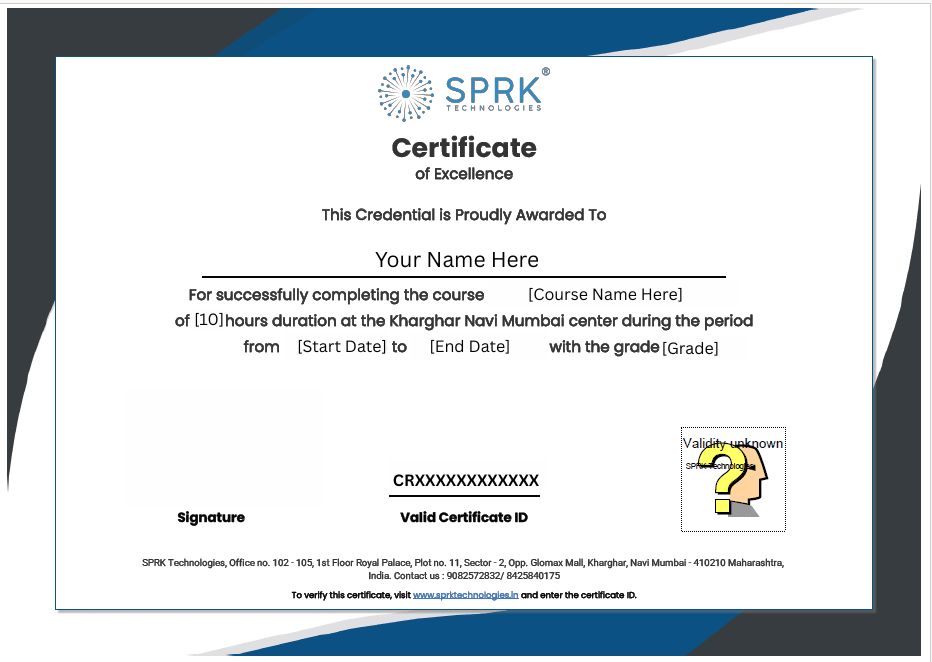
Verifiable Certificate Upon Completion
Earn an industry-recognized certificate that validates your expertise and helps you stand out to employers.
Industry Recognized
Certificate valued by top IT companies
Verified Credentials
Blockchain verified authenticity
Career Boost
Stand out in job applications
Lifetime Validity
Never expires, always relevant